

Why code context is now a core engineering problem
AI coding assistants have fundamentally changed the pace at which engineers write code. GitHub Copilot can generate a function in seconds. Claude Code can refactor an entire module in one prompt. But there is a gap that these tools do not address: context outside of the project.
It has no access to all your repositories at once, no institutional knowledge, and in most cases no awareness of decisions made six months ago. The result: duplicated code, repeated meetings, and onboarding cycles that stretch for weeks.
This is the problem that a new category of tools is trying to solve: AI-powered knowledge and collaboration layers built specifically for engineering teams.
The main categories of AI coding tools for tech teams
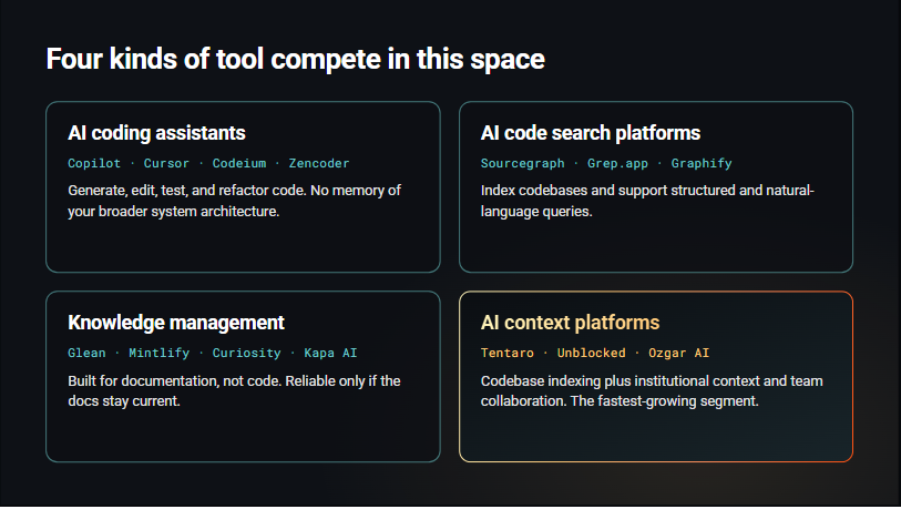
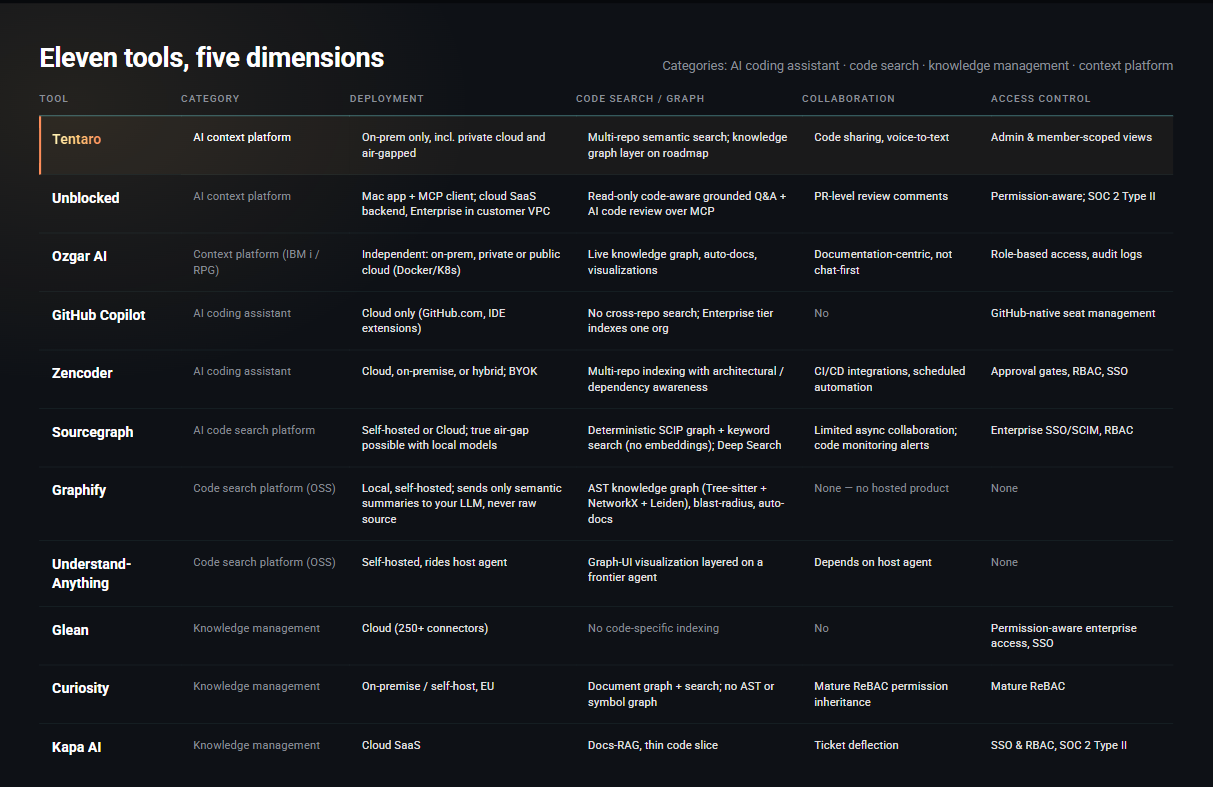
Before comparing specific products, it helps to distinguish between four types of tools competing in this space:
AI coding assistants (GitHub Copilot, Cursor, Codeium, Zencoder) generate, edit, test, and refactor code. They work at the file or agent level and have no memory of your broader system architecture.
AI code search platforms (Sourcegraph, Grep.app, Graphify, Understand Anything) index codebases and support structured and natural language queries. Sourcegraph's Deep Search provides agentic AI search across large monorepos.
Knowledge management tools (Glean, Mintlify, Curiosity) are designed for documentation, not code. They work well for product specs and wikis, but engineering teams rarely keep documentation current enough for these tools to be reliable.
AI context platforms (Tentaro, Unblocked, Ozgar AI) combine codebase indexing with natural-language interaction, institutional context, and team collaboration features. This is the fastest-growing segment and the one with the most direct impact on team productivity.
Tentaro - cross-repository AI code context with team collaboration built-in
Tentaro is built around a specific hypothesis: the biggest productivity loss in engineering teams is not slow code generation, it is the inability to find and share institutional knowledge across repositories and people.
The platform indexes all connected repositories and allows developers to query in natural language. A question like "Where do we handle authentication across services?" returns results with source-tagged references from multiple repos simultaneously, not a list of files to manually inspect.
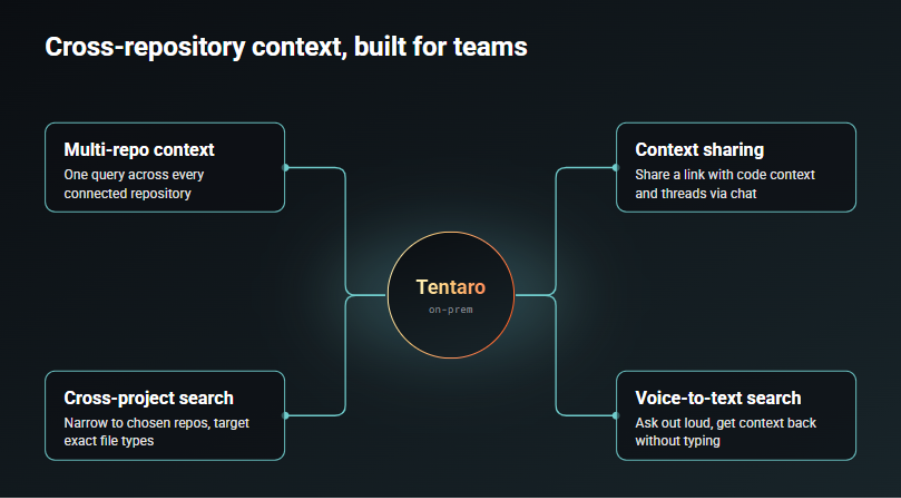
Multi-repository AI code context
Unlike general AI assistants that operate within a limited project context, Tentaro searches across all repositories in a single query. Results include file references, repository labels, and code snippets, synthesized into a readable answer.
Cross-project search
Narrow results by selecting specific repositories or projects, and use natural-language prompts to target exactly the file types you need - from configs and schemas to tests, components, and backend services.
Context sharing via chat
Tentaro allows sharing a link with code context and threads via chat across projects and teams. This is particularly useful in organizations with multiple product lines or microservice architectures, where a decision in one repository affects another.
Voice-to-text search
Developers can just ask a question out loud and get the context back, without breaking their flow to type it out.
Incremental indexing, permanent knowledge
Unlike local agents such as Claude Code, Tentaro doesn't need to re-search files and rebuild context from scratch every time. All projects are indexed centrally, once, and that knowledge stays available to every other member of the team afterward, one indexing job for the whole team, instead of each developer repeating the same local indexing on their own machine.
Security, deployment, and lightweight LLMs
Tentaro runs entirely on-premise, including private-cloud and fully air-gapped setups – the full AI stack stays inside a team's own infrastructure, with no dependency on a vendor model provider. Answers are grounded in the team's own repositories only, so sensitive code never has to leave the network to get indexed or queried.
The platform can also run on lightweight LLMs instead of routing every query to a frontier model, cutting inference cost and resource use for teams operating at scale. Access is available through both a Web interface and an MCP server, so teams can query Tentaro directly or plug it into MCP-compatible tools like Claude Code without switching context.
Where each AI coding tool fits
The question is not which tool is best in isolation, it is which combination solves the actual bottlenecks in your team.
For greenfield projects with small teams, GitHub Copilot or Cursor combined with Slack is often sufficient. The codebase is small enough that developers carry context in their heads.
For teams with more than 100 repositories or fifty engineers working remotely, institutional knowledge starts to drift. Someone leaves, a decision gets made without being documented, onboarding takes weeks instead of days. This is where a code context layer like Tentaro provides measurable return.
For enterprise teams with complex access control requirements Sourcegraph leads with deterministic, compiler-accurate navigation and mass-change tooling at massive scale, with AI search added on top; Tentaro leads with semantic, cross-repo Q&A and running it’s full AI stack on-prem without dependency on a vendor model provider.
What to look for when evaluating AI coding tools for tech teams
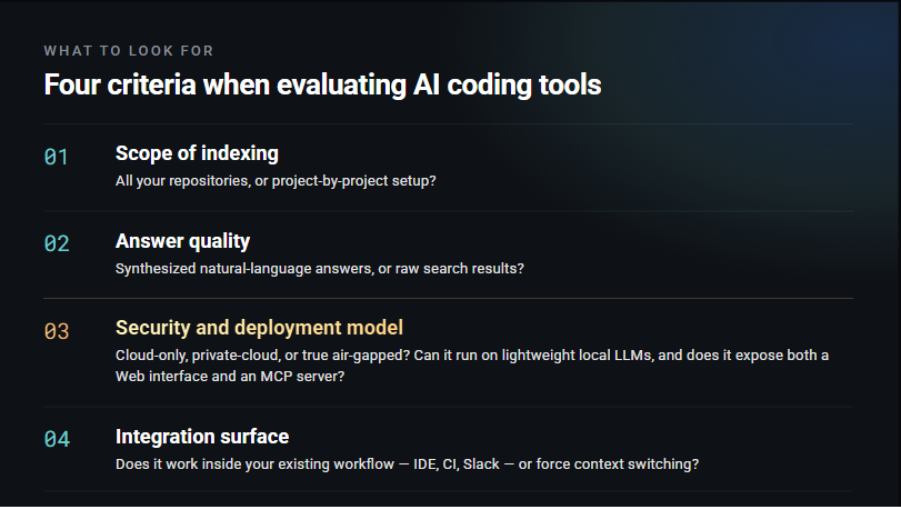
When assessing tools in this category, the key criteria are:
- Scope of indexing - does the tool access all your repositories or require project-by-project setup?
- Answer quality - does it return synthesized natural language answers or raw search results?
- Security and deployment model - is it cloud-only, private-cloud, or true air-gapped? Can it run on lightweight/local LLMs to cut inference cost and resource use, rather than requiring a frontier model for every query? Does it expose both a Web interface and an MCP server, or lock you into one surface?
- Integration surface - does it work within your existing developer workflow (IDE, CI, Slack) or require context switching?
Summary
AI coding assistants solve the "write code faster" problem. They do not solve the "understand and share our codebase" problem.
The competitive landscape around that gap is no longer empty, though: Unblocked contests the same center directly, free OSS tools like Graphify and Understand-Anything have made the underlying code graph much cheaper to get, and sovereignty-forward platforms like Sourcegraph and Curiosity are closing the deployment gap that used to separate the leaders from the rest. Tools like Tentaro address the second problem by combining cross-repository AI search with collaboration features: code sharing and voice to text search. For engineering teams dealing with knowledge fragmentation, repository sprawl, or high onboarding costs, this category of tooling is worth evaluating. The competitive landscape for AI code agents is early. and the feature sets are evolving quickly. The teams that integrate AI knowledge layers now will have a structural advantage in developer productivity and institutional memory retention.
Want to know more? Book a meeting to talk about the best option for your tech team
- What is an AI coding assistant, and what does it not solve?
An AI coding assistant, such as GitHub Copilot or Zencoder (Zenflow), generates, edits, tests, and refactors code at the file or agent level. It operates within the scope of the project currently open in the IDE and has no persistent memory of decisions made in other repositories or by other team members.
- How is an AI code search platform different from a coding assistant?
AI code search platforms, such as Sourcegraph or the open-source Graphify and Understand-Anything, index existing codebases and expose them to structured or natural-language queries, rather than generating new code.
- Can knowledge management tools like Glean or Kapa AI replace a code-specific platform?
Not for engineering use cases. Knowledge management tools such as Glean, Curiosity, and Kapa AI are built to index documentation, wikis, and support content, not source code — Glean explicitly has no code-specific indexing, and Kapa AI's retrieval only covers a thin code slice on top of docs-RAG. They work well when documentation is kept current, but engineering teams rarely maintain documentation reliably enough for a docs-only tool to substitute for something that reads the actual codebase.
- What distinguishes an AI context platform from the other three categories?
AI context platforms, including Tentaro, Unblocked, and Ozgar AI, combine codebase indexing with natural-language interaction and team collaboration on top, closing the gap that coding assistants, search platforms, and documentation tools each leave open individually.