Your AI writes code.
Tentaro remembers it.

Tentaro reads your repositories and answers questions about them, with the files behind every answer attached. The same context goes to your AI tools over MCP, so the assistant writing the change knows the system it is writing into.
Runs on your infrastructure
Never trains on your code
Every answer lists the files it came from
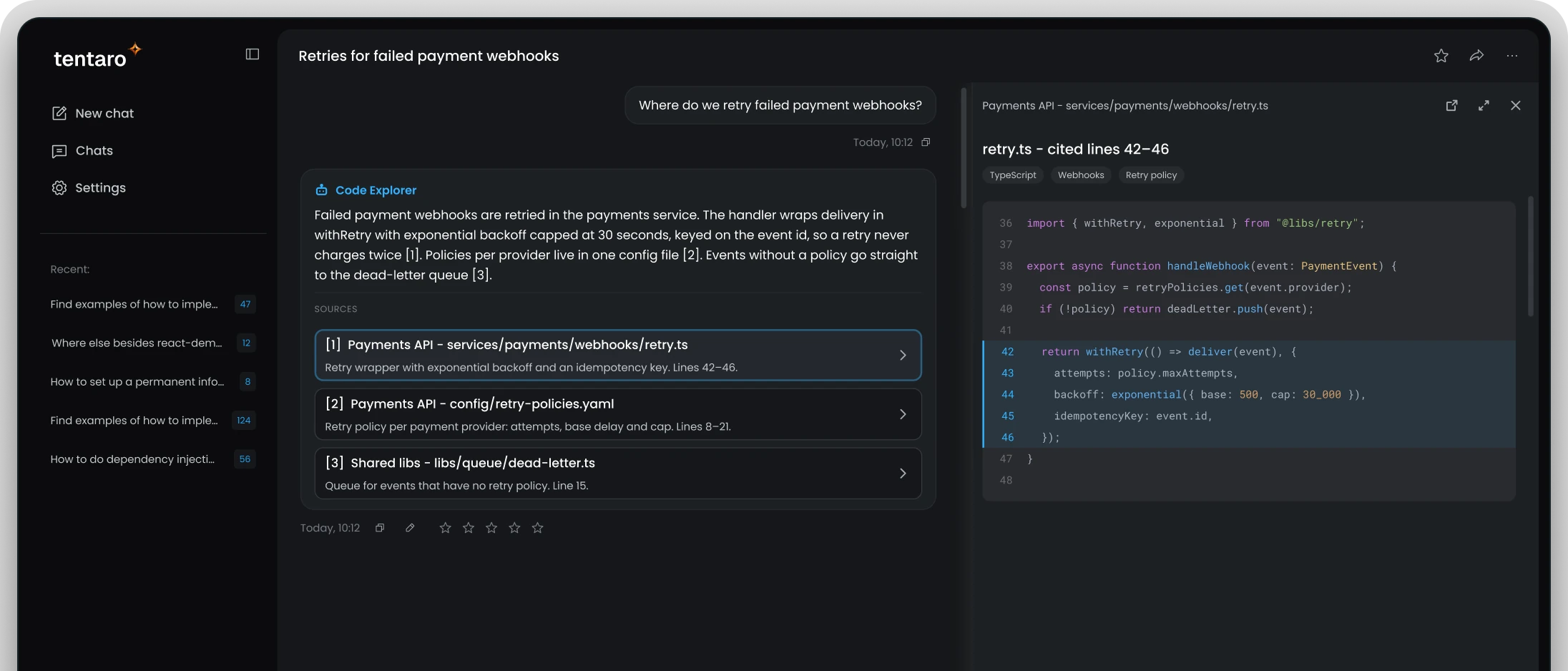
Tentaro interface: a question about payment webhook retries answered with cited files and the exact lines highlighted in the source.
100+
repositories reasoned across in a single deployment
15 years
of enterprise code indexed and queried by our own team every day
0
files returned when nothing in your code matches the question
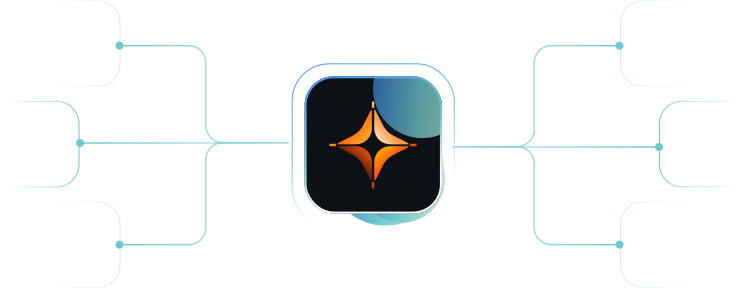
Six tool icons connected to the Tentaro mark at the centre, showing one shared source of context feeding every assistant.
WHAT IT IS

Three things, in order.

Tentaro is not a coding assistant and not a search box. It is the layer that knows your system and hands that knowledge to whoever is asking.
01
It reads
Every repository you connect, re-indexed only where it changed, so the map stays current as the code moves.
02
It retrieves
The parts of your system that relate to the question, and nothing at all when none of them do.
03
It answers
To an engineer in the interface, or to a coding assistant over MCP, with its sources attached.
Code generation: never. Tentaro is read-only by design. It can tell you what your code does, and it cannot change a line of it. A tool that cannot write is a much smaller risk than one that can.
WHERE YOU USE IT

The same context for your engineers and their AI tools.
The same context serves the person asking a question and the model writing the change.
FOR YOUR ENGINEERS
Ask in plain language, verify in the code.
Every answer arrives with the files it used. Open them in place, read the code yourself, send the thread to whoever does the work.
Which services still call the legacy auth client?
billing/api/session.ts
orders/core/client.ts
admin-tools/login.py
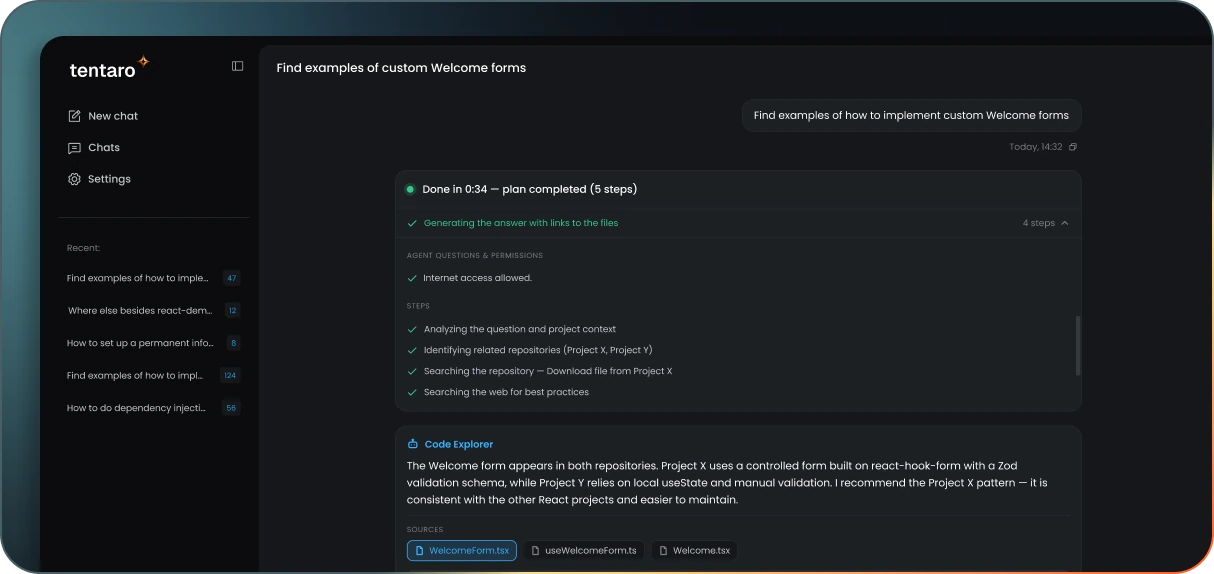
Tentaro answering a question about custom Welcome forms, with the plan it followed and the files it cited.
FOR YOUR AI TOOLS
Your assistant asks first, then writes.
Connects to Copilot, Cursor, Claude Code and Codex over MCP.
One question instead of twenty opened files.
~/.config/mcp.json
Copy
{
  "mcpServers": {
    "tentaro": {
      "url": "https://tentaro.internal/mcp",
      "transport": "http"
    }
  }
}
Copilot
Cursor
Claude Code
TOKENS
Fewer tokens spent getting oriented.
The model stops re-reading your repositories to find its bearings, and keeps the context window for the work.
SCOPE
Context spans every connected repository.
Not the one that happens to be open in the editor. Services, shared libraries, the internal tools nobody documented.
Several repositories linked into one context node.
FIT
We do not replace the tools your engineers chose.
Tentaro feeds them. Whatever writes the code keeps writing it, only now it knows your system.
THE PROBLEM

How your system works lives in a few people’s heads

Sentences we hear in almost every engineering organisation we talk to.
“Only David knows how it works.”
One person is the documentation, and the roadmap waits for their calendar.
“We inherited this. Nobody wants to touch that service.”
The risk of changing it is unknown, so it does not get changed.
“Our documentation is aspirational.”
Written once, stale within a quarter, trusted by nobody.
“The AI doesn’t have a mental model of our app.”
It writes confident code against a system it has never seen.
“Velocity is flat even though we shipped AI tooling to everyone.”
More code arrived. Review capacity did not.
“We can’t use Copilot, our code can’t go to the cloud.”
The tools that would help are the ones security already said no to.
Different sentences, one problem.
How your system works lives in a few people, not in anything a tool can read.
64%
Median pull request size up year over year
getdx.com
106%
More significant lines per human-landed diff, with over 80% of that growth from agentic AI
Meta, via getdx.com
70%
Of PostHog’s monorepo pull requests are now opened by agents, up from 20% in four months
PostHog
WHY NOW

Generation got cheap. Understanding did not

Today
With Tentaro
Architecture questions route through the same three people
The answer comes from the code, not from someone’s memory
A new engineer spends months before they are useful
A new engineer asks the code instead of a senior
An agent's pull request touches three repositories; the reviewer has one of them open
The reviewer asks what the other two do and reads the answer with the files attached
Four implementations of the same retry handler
Someone checks whether it exists before writing the fifth
Your AI re-reads your repositories at the start of every session
Your AI starts every session with the context already there
Somebody resigns and the knowledge leaves with them
The knowledge stays where the code is
Take the retry handler. Four versions already exist in four repositories, and the engineer about to write the fifth has none of them open. One question to Tentaro returns the four, with files. The fifth never gets written, reviewed or maintained.

Sometimes the honest answer is nothing.

Every other assistant will produce something. Ask about a service it has never seen and you get a confident, wrong answer, and no way to tell.
Tentaro applies a hard relevance threshold. Below it, the answer is that nothing in your codebase matches. A quieter demo, and a far more useful production system.
WHERE IT RUNS

Your code stays where your compliance officer can point at it.

Built for teams whose code is not allowed to leave their own infrastructure, whether that comes from a regulator, a customer contract, or an internal rule that predates both. Where the code sits is the first question on the list. There are three answers.
Cloud
On-premise
Hybrid
Hardware
Lightweight models on commodity hardware. Your own machines or your own private cloud, whichever you already have. You size it once.
License
From $1,000 per month, one license per deployment. Not per seat, not per question, not per token.
Your boundary
Connecting Tentaro to cloud assistants over MCP is a choice you make, not a default. Nothing leaves unless you connect it.
No training on your code
Your code is never used to train models. Not ours, not anyone else’s.
ACCESS
Permissions are not an afterthought.
Answers inherit the repository permissions your organization already maintains. A user is never shown content from a repository they cannot already access.
Deploying into a disconnected environment? →
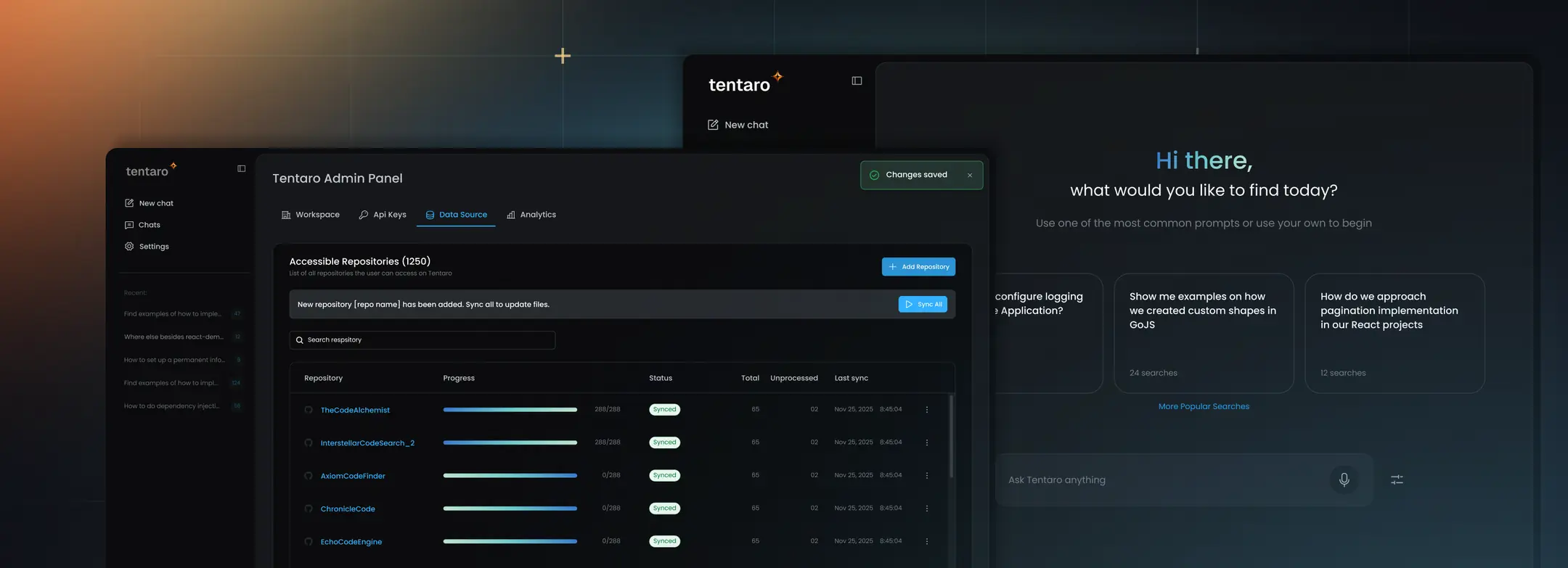
Tentaro admin panel and chat interface
SPECIFICS

What works today.

Languages

Language agnostic. Tentaro indexes whatever your repositories contain, including the parts nobody on the current team wrote. Wondering about a specific stack? Ask us. The answer is about how well it works on yours, not whether it works at all.

Repositories

GitHub Enterprise, GitLab self-hosted, Bitbucket Server, Azure DevOps Server, Perforce.

Multi-repository reasoning

Default, not an add-on.

Asking

Type a question, or ask it out loud.

Indexing

About 10,000 files a day on a single workstation GPU. There is no cluster to buy before you find out whether this works for you.

Answer speed

Seconds. The size of your repositories does not change that.

Permissions

Answers inherit your existing repository permissions. A user is never shown content from a repository they cannot already access.

Your own model

The model that generates answers can be replaced with one you choose, and it runs on your hardware or in your private cloud either way.

Training on your code

Never.

Code generation

Never. Tentaro is read-only by design.

On the roadmap

SOON

Documentation sources beyond code, and a knowledge graph over the codebase.

Everything above the roadmap row is available today.

The Synergy Codes team at work
BUILT WHERE THE PROBLEM IS

We built this for ourselves first.

Tentaro was built inside a software company with fifteen years of enterprise delivery and a codebase that got large enough to stop fitting in anyone's head. It was an internal tool before it was a product, and it still runs on that codebase every day.

That is the whole origin story. No research lab, no benchmark chase. A team that needed to find things in its own work.

Tentaro is early. It runs every day inside the company that built it, and we are in design-partner conversations with engineering teams that cannot move their code. We would rather tell you that than show you a logo wall we do not have.

Early has terms. Design partners get two months of pilot at no cost, direct access to the people who build it, and a say in what ships next.

THE PEOPLE BEHIND IT
Łukasz Jaźwa, CTO at Synergy Codes
CTO

“New developers reach productive work about 40% faster than before we had it.”

We set the relevance threshold high on purpose. The first version answered everything, and every answer sounded right. Plausible is worse than nothing when somebody is about to change a payment path.

Łukasz Jaźwa

CTO, Synergy Codes

Aleksandra Bury, CEO and co-founder of Tentaro
CEO AND CO-FOUNDER

“I spent years in operations watching good engineering teams lose weeks to questions only three people could answer.”

Aleksandra Bury

CEO and co-founder, Tentaro

Łukasz Jaźwa · CTO
Aleksandra Bury · CEO
←
→
TRY IT

72 hours, no installation.

The demo runs the full engine on reference repositories we prepared, so you can see how it answers before anyone talks about access to your code. Invite your team, ask hard questions, share the answers.

Work email only. No credit card, no installation, no access to your repositories.

Watch the walkthrough
01

Enter a work email. Access opens in about a minute.

02

Ask anything about our reference repositories, including the questions you would use to catch it out.

03

Invite your team into the same workspace and share threads.

04

After 72 hours the workspace closes. Pointing it at your own repositories starts with a call.

QUESTIONS

Answers before you ask us.

Is Tentaro a coding assistant?

No. It never generates code. It supplies the context that coding assistants lack about your specific system, delivered over MCP.

How is this different from code search?

Search returns files that match. Tentaro returns an explanation grounded in the files that matter, with the references so you can check it, and nothing at all when your codebase does not contain an answer.

Which languages does it work with?

All of them. Tentaro is language agnostic: it indexes whatever your repositories contain, in any language, including the parts nobody on the current team wrote. If you are wondering about a specific stack, ask us. The answer is about how well it works on yours, not whether it works at all.

Which repositories can it connect to?

GitHub Enterprise, GitLab self-hosted, Bitbucket Server, Azure DevOps Server and Perforce, among others. Multi-repository reasoning is the default, not an add-on.

What happens when it does not know?

It says so. A hard relevance threshold means the system returns nothing rather than a plausible guess.

Does our code leave our infrastructure?

In the on-premise deployment, no. Repositories, indexes and inference stay inside your environment.

Do you train models on our code?

No.

What does it cost to run?

The answering side runs on lightweight models on commodity hardware, in your own infrastructure. The cost scales with the hardware you provision, not with how many questions your team asks.

What is on the roadmap?

Documentation sources beyond code, and a knowledge graph over the codebase. Both are roadmap; everything described above ships today.

Take this page to your own assistant.

We publish this page as plain text for models to read. Ask your assistant to compare us, challenge us, or summarise it for your security team.


Keep what makes your software yours.

Every system holds knowledge that took years to build and lives in a handful of people. Tentaro keeps it where the code is, available to your engineers and to the AI they work with, on infrastructure you control.