

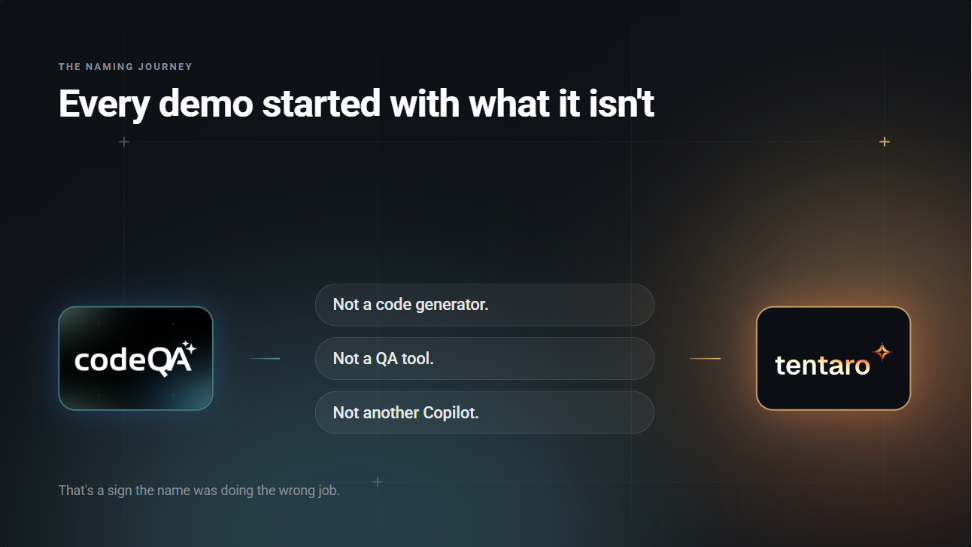
For the past year, every time we showed CodeQA to someone, we spent the first few minutes explaining what it's not.
Not a code generator. Not a QA tool. Not another Copilot.
That's a sign the name was doing the wrong job.
Today, we're excited to announce our new name: Tentaro.
The naming journey
CodeQA made sense when we started. We were building search for code, and "QA" nodded to questions and answers But the name kept pulling people toward the wrong mental model: testing, quality assurance, another checkbox tool in the CI pipeline.
That's not what we do. We never generated a single line of code, and we never ran a single test. We index. We search. We explain. Many demos started with a correction instead of a conversation.
So we went back to what the product actually does: it gives AI, and the humans using it, the context they're missing about a codebase.
The new name carries a story. Picture a traveler crossing a dark forest at night. When they need it, they return to the camp: warmth, safety, people who share what they know. A stop. A moment of understanding. Then the journey goes on.
Tentaro is that camp, and the guide who remembers the way.

The name is built from three pieces. Tent: shelter, the base you come back to. Tarō: Japanese for the one who goes first - a guide. Tentare: Latin for to try, to explore. It sounds like a person's name, and that is on purpose - the product works like a colleague who remembers, not like another tool in the pipeline.
And it doesn't compete for the same shelf as Copilot or Cursor, because we're not on that shelf. We're the layer underneath them.
What Tentaro is
Your team already has tools that write code: Copilot, Cursor, Claude. They're genuinely useful. But every one of them is only as smart as the context it's handed, and most of the time, that context is missing.
They see the file that's open. They don't know your platform's history, conventions, or how its pieces connect across repositories.
Tentaro is that context.
We give your team, and your AI assistants, the real picture of your codebase: the what, and the why. Every answer comes straight from your own repositories, including the code that never leaves your infrastructure.
Not a coding assistant. A context platform.
The road ahead
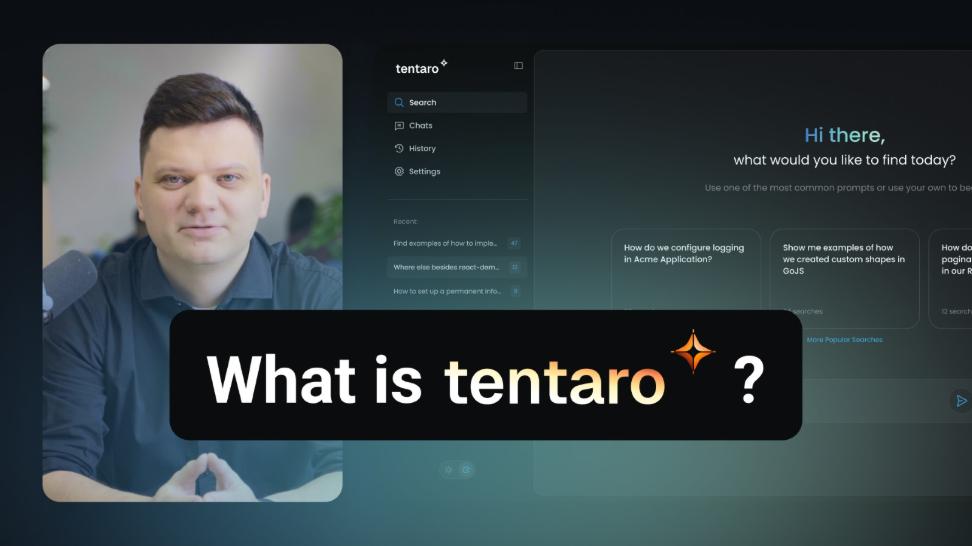
Search was step one. Tentaro already runs on-premise, searches across multi-repo codebases, and plugs into Claude through an MCP server, no separate UI required. We added voice-to-text search, so developers can just ask a question out loud and get the context back, without breaking their flow to type it out.
The next problem is bigger: helping teams reason about impact, not just retrieve a file, turning every question a developer asks into context-aware intelligence, not just a pointer to a relevant snippet.
We're focused on deepening that core experience before we chase anything new: better coverage across sprawling multi-repo setups, and tighter integration with the tools developers already use.
The same shift is coming for agents. As coding agents move from suggesting lines to running autonomously across a codebase, the cost of missing context stops being an inconvenience and becomes a risk: an agent acting on the wrong assumption doesn't just slow someone down, it ships. Tentaro is built to be the context layer those agents call on before they act, not after something breaks. That's the direction we're building toward. Sharper name, sharper focus on what we're actually solving.
Thank you
To everyone who used CodeQA, asked hard questions in demos, and pushed back when something didn't quite fit: thank you. You're the reason the name changed and the product didn't have to.
Same product you've come to know. New name that finally says what it does.
Welcome to Tentaro.
Get in touch: tentaro.ai · Try a demo
#announcement #rebrand